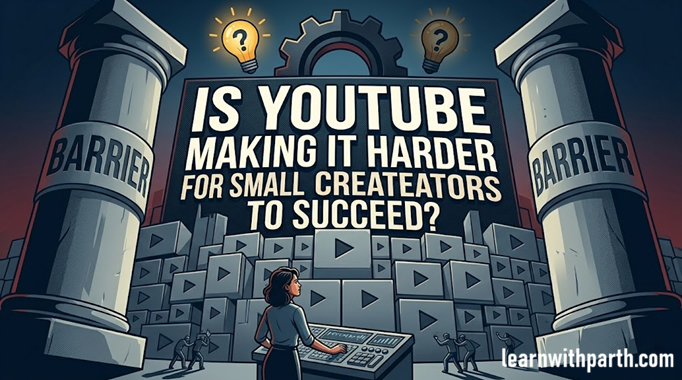
You made your first video. You spent hours on it. You uploaded it. And then… nothing. Maybe 12 views. Three of them were you.
So you start wondering — is YouTube broken? Is the game rigged? Are big creators just eating everything?
The honest answer is: yes, it is harder now. But not for the reason most people think.
It Feels Harder Because It Actually Is
Five years ago, you could upload a simple video and get views just because not many people were doing it. Today, over 500 hours of video are uploaded to YouTube every single minute. Every. Single. Minute.
That means when you upload your video, it is fighting against thousands of other videos uploaded at the same time — in your same topic, your same language, your same audience.
More people uploading = less room for each video. That is just math.
The Algorithm Does Favor Big Channels — Here Is Why
A lot of small creators think YouTube hates them. YouTube does not hate you. YouTube just loves one thing more than anything else — watch time.
Here is how it works. When you upload a video, YouTube shows it to a small group of people first. Maybe 50 to 200 people. It then watches what those people do. Do they click? Do they watch the full video? Do they leave after 10 seconds?
If people watch, YouTube pushes your video to more people. If they leave fast, YouTube stops pushing it.
Big channels win this game easily. Why? Because they already have people who love them. Their subscribers click fast, watch long, and come back for more. A new channel has none of that history. So the first test is harder to pass.
This is not YouTube being evil. It is YouTube doing what every business does — showing people what already works.
The Monetization Wall Feels Very Far Away
To make money on YouTube, you need 1,000 subscribers and 4,000 watch hours in the last 12 months. That sounds simple. But for a new creator with zero audience, it can take 1 to 3 years — or never happen at all.
And here is the painful part. Until you hit those numbers, you put in all the work but get zero money back. No reward. Just hope.
This waiting period is where most small creators quit. Not because they are bad. But because the wait feels endless and the silence feels like failure.
There Are More Creators Than Ever Before
YouTube used to be hard to start. You needed a camera, editing software, a computer that could handle video. Today, your phone does all of it. Recording, editing, uploading — all from one device in your pocket.
This is great news for people who want to create. But it is hard news for people who want to grow. Because when the barrier to start goes down, millions more people start. And they are all fighting for the same viewer attention.
Your competition is not just the big creators with 1 million subscribers. It is also the person who started their channel last week, just like you.
Most Small Creators Lose Before the Algorithm Even Sees Them
Here is something nobody tells you early enough. The algorithm is not your first problem. Your thumbnail and your title are.
Before YouTube pushes your video to anyone, a real person has to click on it. And that person decides in less than one second — based only on your thumbnail image and your title words — whether to click or scroll past.
Most small creators make videos with bad thumbnails and boring titles. Not because they are lazy. But because nobody taught them that this is the most important skill on YouTube.
A great video with a bad thumbnail gets zero views. A decent video with a great thumbnail can go viral. That is the harsh truth.
Shorts Changed the Game — But Not Always in Your Favor
YouTube Shorts — the short, fast, vertical videos — were supposed to help small creators grow faster. And sometimes they do. You can get 100,000 views on a Short even with zero subscribers.
But here is the problem. Shorts views and long video views are very different things. People who watch Shorts are in fast-scroll mode. They are not looking for a creator to follow. They are just looking for something fun for 30 more seconds.
So you can get a million Shorts views and still have 80 subscribers who never watch your long videos. The growth from Shorts often does not transfer to real channel growth.
Long videos build real fans. Shorts bring eyeballs. Those are two different things, and mixing them up confuses a lot of new creators.
But YouTube Has Also Done Some Things That Help Small Creators
It is not all bad news. YouTube has actually made some real changes to help smaller channels.
In 2023, they lowered the first step of monetization. You can now join the YouTube Partner Program at just 500 subscribers (with some limits), compared to 1,000 before. That means you can start earning from memberships and channel features earlier.
YouTube also now actively looks for "breakout" videos — videos from small or new channels that show early signs of doing well — and pushes them harder. Their own team has said publicly that they want to find the next big creator, not just reward the ones already big.
And the Shorts feed specifically gives new creators a real shot. A great Short from a zero-subscriber channel can and does go viral. That was almost impossible with long videos five years ago.
The Biggest Mistake Small Creators Make
You ready for this? The biggest mistake is trying to copy big creators.
You see MrBeast doing massive production videos. You think — I need to do that. You see a gaming channel with perfect editing. You think — I need that too.
But big creators have teams. They have money. They have years of learning behind them. Copying their output without their resources just makes you look like a worse version of them.
The small creators who actually grow fast do the opposite. They go very, very specific. Instead of "cooking channel," they do "5-minute Indian meals for college students." Instead of "fitness channel," they do "workouts for people with bad knees."
Specific topics bring specific people. Specific people become loyal fans. Loyal fans tell their friends. That is how small channels grow — not by going big, but by going narrow.
What Small Creators Who Are Actually Growing Do Differently
If you look at channels that started small in the last two years and actually grew, they all share a few things:
- They post consistently. Not every day. But on a schedule. One video a week, every week, for a full year. The algorithm rewards channels that upload regularly. It learns when you post and starts expecting it.
- They study their analytics. Not to feel bad about low numbers. But to find which videos got more clicks, more watch time, more comments. Then they make more videos like those.
- They write their title and thumbnail first. Before they even record. They ask — will someone click this? If the answer is not a strong yes, they change it.
- They respond to every comment in the first hour. Early comments tell YouTube that people are engaging. More engagement = more push from the algorithm.
- They do not chase trends. They pick a lane and stay in it. YouTube wants to know what your channel is "about." If one week you post cooking and the next week you post travel, YouTube cannot figure out who to show your videos to.
The Honest Truth About YouTube in 2026
Is it harder? Yes. More competition, smarter algorithm, higher viewer expectations — all of it is real.
But here is the thing. Harder does not mean impossible. It means you have to be smarter about it.
The people quitting right now are actually making it a little easier for you. Every creator who gives up after 10 videos is one less person competing for your audience.
YouTube is still one of the only places in the world where a person with zero money, zero connections, and just a phone camera can build a real audience and real income. That door is still open.
It just does not open from the outside anymore. You have to knock — with a great thumbnail, a specific topic, and the patience to keep showing up when nothing seems to be working.
That is the game. And now you know the rules.
Want to start? Pick one topic you know better than most people. Make your first 10 videos about only that topic. Do not think about views. Think about getting better with every upload. The algorithm will find you — but only if you keep going.